🎬 Free Live ClassAll Levels📅 October 22, 2026· 1h 05m
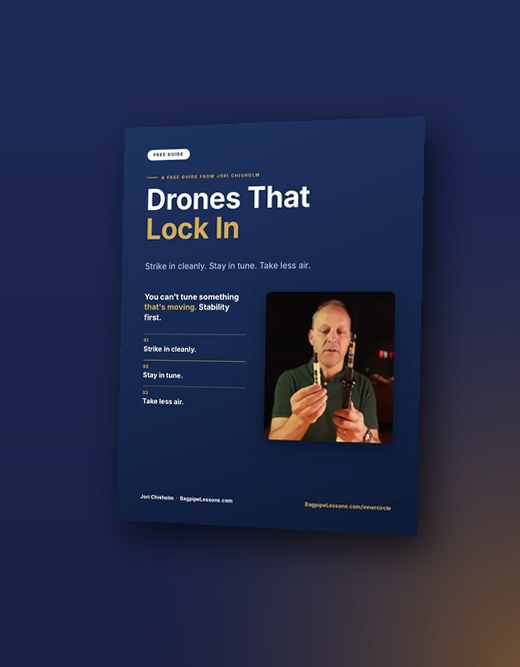
Drones That Lock In
Thanks for joining me live. Here is the full replay, the chapters so you can jump straight to the bit you want, my notes, the questions I answered, and the complete transcript. — Jori
This is what every class looks like inside the Inner Circle. A live class with me every week, and every replay lands in the library like this one — chapters, notes, Q&A, and a transcript you can search to the exact second.
Stability first: you can't tune something that's moving. A good drone only changes pitch when your hand moves it. If it wanders on its own or swells with your blowing, look at the reed, its setup, moisture and your blowing before you worry about tone.
Match your drone reeds to your chanter reed. High A on your chanter sets the pressure for the whole bagpipe. Move each bridle about a millimeter at a time so the drone kicks into its second tone comfortably below that pressure and never shuts off while you play. Less air, lower pressure and a steadier sound all go together.
Low A is the master note, and tune once your pipes settle. Tenors and the bass top with a little hemp showing, the bass bottom low. Tune with the InTune Mic or by ear, matching the bass to the outside tenor, and do your fine tuning once low A stops rising.
⏱️ In this class
01:02Drones that lock in: is it real?
03:58Three things you want from your drones
04:32A wall of sound, and why tone wins contests
06:40Stability first: you can't tune something that's moving
10:18How a drone reed works
13:09The four levels of a drone reed, demonstrated
16:38The bridle: close it down or open it up
19:27Too hard, or taking too much air?
22:45High A sets the pressure for everything
24:02Matching drone reeds by feel, or with the Bagpipe Gauge and Reed Tester
29:34The secret of great pipers: easy pipes
30:50Where your drones should sit, and the tuning screw
36:02Tuning: the InTune Mic, by ear, and letting your pipes settle
41:04Whistles, new drone reeds and moisture control
44:54Your questions: tuning, a tricky middle tenor, double toning
49:07Drone valves, and the extreme-pressure calibration myth
55:16A wavering bass, extenders, a buzzy bass
01:00:27My favorite drone reed set
About this class
This free class is all about drones that lock in: drones so steady and so in tune that they sound like one, and seem like they can't go out of tune. I used to think that was a story pipers told each other. It's real, and in this class I show you how to set your pipes up to get there. We work on three things you want from your drones: strike in cleanly, stay in tune, and take less air so your pipes are comfortable to play.
I start with stability, because you can't tune something that's moving. I show how a drone reed works, with an Ezeedrone and a Selbie on the drones in front of me, and demonstrate the four levels of a drone reed: no sound, first tone, second tone and shut-off. Then the bridle, the first adjustment, and how closing it down or opening it up changes every level. I explain the difference between pipes that are too hard and pipes that take too much air, why high A on your chanter sets the pressure for everything, and how to match each drone reed to it, by feel or with the Bagpipe Gauge and the Precision Reed Tester and Drone Adapter.
In the second half I cover where your drones should sit and why, the tuning screw, the double-toning bass, and tuning with the InTune Mic or by ear, plus why you wait for your pipes to settle before you fine-tune. I finish with moisture control, when to replace drone reeds, and a long round of questions from pipers on drone valves, a wavering bass, a tricky middle tenor, drone reed extenders, a buzzy bass and my favorite drone reed set.
“You cannot tune something that's moving around.”
“Everything you do to make your drones take less air also lowers the pressure and makes them steadier. Isn't that great?”
✓Stability comes first. A good drone changes pitch only when you move it. If it wanders on its own or moves with your blowing, it can't be tuned, no matter how good it sounds.
✓Every good drone reed has four levels: no sound, a first tone on the strike-in, a second tone that is your full playing sound, and shut-off at high pressure. If a drone reed only has one tone, something is wrong with it, usually that it's taking too much air.
✓The bridle is the first adjustment. Close the reed down and every level happens at a lower pressure with less air. Open it up and every level happens at a higher pressure. Move it about a millimeter at a time.
✓Too hard is pressure, and it comes from the chanter reed. Too much air is air escaping, and one of the most common causes is drone reeds that are too open.
✓High A on your chanter sets the pressure for the whole bagpipe. Set each drone reed so it kicks into its second tone comfortably below that pressure and never shuts off while you play. The Bagpipe Gauge with the Precision Reed Tester and Drone Adapter puts a number on each reed.
✓Tenors and the bass top should tune with a little hemp showing, about 1/8 to 1/2 inch, and the bass bottom low, one or two fingers. A bass that won't start usually has its two sections reversed. Use the tuning screw to move where a drone sits: the drone goes the same way as the screw.
✓Low A is the master note. Tune with the InTune Mic, or by ear: middle tenor off, match the bass to the outside tenor, check against low A, move them together, then bring the middle tenor back in. Fine-tune once low A has stopped rising.
✓Keep drone reeds warm and dry with moisture control like the Dri-Flo, never flick the tongues, and replace a set when there's no sweet spot left. A couple of years of regular playing from a set is good value.
QI've played for six years and still struggle to tune my drones, even with a tuner. What should I check?
A: It could be your blowing, so put the Bagpipe Gauge on and look at your pressure, and check whether your drone reeds are taking too much air. Then cork the chanter and two drones and play one drone alone with the InTune Mic. If the tuner is going up and down, the reed needs adjusting or your blowing is too wild. Test each drone that way, because it could be one drone causing all the problems.
QI can't get my middle tenor reed adjusted correctly, and I've tried several reeds. What now?
A: Do an experiment. Your tenors are twins, so swap the reeds. If the problem stays with the drone, the drone is the problem. If it moves with the reed, the reed is the problem. Look inside the drone too, and check your moisture control hose for a crack or a blockage.
QHow do I correct double toning on my drones?
A: On the bass, get the bottom section nice and low. If your drones kick in but keep dropping back to the first tone or fluttering while your chanter plays, they want more pressure than you're giving them, so close the bridles down.
QWhat do drone valves do, other than reduce the air?
A: I don't play them and generally don't recommend them. Good drone reeds that are set up properly don't need them, because they have a kind of built-in back pressure. With students, when we get good reeds or adjust their reeds and take the valves out, everything is better, and you have one less thing to adjust.
QIf I adjust my drone reeds to be super efficient, won't they shut off when I play my chanter?
A: Not necessarily. A Selbie can kick into its second tone at about 12 and not shut off until well past 30, which leaves plenty of room for your chanter reed. Test your reeds in the range where you actually play, not at some extreme pressure you'd never blow.
QMy bass drone wavers while my tenors stay steady. Is that normal?
A: On most sets of pipes the bass is a little less stable than the tenors, even in the best of times. The reed is bigger, the tongue is more open and more air goes through it.
QWhat are drone reed extenders for?
A: If you play a B-flat chanter to play with other instruments in concert B-flat, your pitch drops to around 466. An extender goes between the drone and the reed and lengthens the drone, like stilts, so your normal drones and reeds can tune that low.
QA judge said my bass was too buzzy. Should I change it?
A: Before you make big changes, get more data: record yourself and listen back, have someone else play your pipes, ask your instructor or pipe major. What you hear right next to your head can be very different from what people hear in front of you.
📜 Full class transcript
Today's topic is drones that lock in. Years ago, I remember pipers talking about their drones being locked, this idea that your drones are so in tune that they sound like one drone and almost can't go out of tune. That's where this locking-in concept comes from. They're just there, and they're not moving, and it's an amazing feeling. I didn't think it was actually real. I thought, this can't be a thing, because I never experienced it, but it is real. There's a feeling you can get where the drones are in tune, they stay in tune, and it seems like they won't go out of tune.
Before we get started, the way Zoom works is there's a chat button. I'd love it if you would hop into the chat and tell us where you're coming from and a little bit about your piping, just a couple of sentences. If you have a question about drones, feel free to pop it in there too, if there's something you really want to learn from today's session. We'll have time for questions later.
I do this kind of thing almost every week. I have a membership called the BagpipeLessons.com Inner Circle. You have access to a lesson library that's getting close to a thousand lessons now, including every one of these Zoom classes that I've done going back to 2020. We're talking hundreds of hours of bagpipe material, all available to watch on replay, and everything is fully indexed, so you can search for exactly what you're looking for.
This website is the coolest, most exciting thing I've done since I launched my business 26 years ago. It's the dream website for me: all of my teaching, all the videos, lessons, tunes, everything in one place. That's why I'm doing these free Zooms this month and next month, so people can learn what these classes are like. If this is your first time, welcome, and I see some familiar faces on here, so welcome back. Check out BagpipeLessons.com/innercircle. If anything like this was around when I was learning to play, I would have been there 24-7.
Today we're going to talk about three things you want out of your drones. You want them to strike in cleanly. You want them to stay in tune, and that's really the main thing. And you want them to take less air, so they're comfortable to play. Keep coming in the chat, this is fantastic. I'm going to try to get through this so we have lots of time for questions and still get you out of here on time.
The bagpipe has this really cool sound, and the drones have a lot to do with it. Every time you play a note on your bagpipe, you're actually playing something like a chord, four notes happening at once. The chanter is playing the melody, but every note on the chanter is played on top of, or along with, your drone notes. That has some really interesting implications for how we tune the chanter, which is a topic for a different session. But it's that wall of sound, the drone, that's the foundation of your bagpipe tone.
If any of you are competing, or are interested in competing, I'll let you in on a little secret. Maybe it's not a secret, but you cannot win bagpipe competitions unless your pipes sound amazing. That's not a rule somebody handed down from some authority. It's that who wins is decided by the judges, and the judges are all pipers, and what judges and pipers love is amazing bagpipe tone. No matter how great your tunes are, no matter how great your fingering is, all the expression, all that stuff, we can't enjoy it if your pipes don't sound great.
And the flip side is that when your pipes sound amazing, bagpipers love you so much. They love what you're doing. When someone plays and you think, wow, those pipes sound amazing, you're just like, all right, play! I'm ready! You're in a state of bliss, or oxytocin, or whatever chemicals are flooding your brain with enjoyment and pleasure and love. That's what happens when you hear a really great sounding bagpipe.
The number one thing you need is stability, because you cannot tune something that's moving around. There's an old story about building a house on a solid rock foundation and not on sand, and that's what's going on here. When I'm looking at a set of bagpipes, or a set of drone reeds, or trying to figure out what's going on with my students' pipes, I don't care anything about the quality of the sound until I've addressed the stability first. If somebody says you've got to check out so-and-so's new drone reeds, and I get a chance to try them and they move around, I'm not playing them. It doesn't matter how good the sound is. If it's not stable, you can't tune it, and if you can't tune it, it drives you crazy. Not fun.
So first, we're going to talk about how to achieve that rock-solid drone tone that doesn't move around. We'll talk about setting it up so it's efficient, and the good news is that stability and efficiency go together. We'll look at how the drone reed works, the bridle and the tuning screws, how to make sure your pressure is matched to your chanter, and how to get your drones tuning in the right position.
What you want is for the pitch of the drone to move only when you move the drone. That's the only cause of changing pitch you want. What you don't want is the drone wandering over time, and you don't want the drone shifting pitch because of pressure fluctuations. We work on steady blowing. I've got another one of these Zoom classes coming up where we'll talk about it, and I have lots of videos on it. But to have a really great tone, you have to do your part, which is blow your pipes, and your instrument has to do its part, which is to be stable and hold its pitch.
You can imagine a drone reed that's really stable and resistant to pressure changes, so even if your blowing goes up and down a little bit, the drone doesn't change. That's what we want. You can also imagine a drone reed that's really sensitive to pressure fluctuations, so if you're steady it's okay, but any little change in your blowing pressure and the pitch goes up and down and up and down. Go around the Highland Games, and you'll see someone whose drones are moving as they blow. That's two problems: unsteady blowing, and a really sensitive drone reed setup, or a drone reed and bagpipe that aren't compatible.
This rock-solid drone sound comes from the reed and how it's set up, from moisture control, because you want those drone reeds nice and warm and dry, not wet, and from the blowing. That's all it comes from. If questions come up as I'm talking, please put them in the chat. I'm keeping an eye on it, and we'll get to them towards the end, or if I happen to see one in the flow here.
A couple of my favorite drone reeds are the Ezeedrone Combo Set and the Selbie. It's a tube with a vibrating tongue, a little piece of plastic that goes up and down. Right now the tongue is sort of open like this, and there's a little gap under there. As I inflate the bag and push air out of the bag, it starts to go under the tongue and out the drone. Right now there's no air pressure, nothing's happening, but as you increase the air pressure, air starts to rush out under the tongue, through the drone reed, and out the drone.
As the air rushes out under that tongue, it creates a pressure differential: lower pressure where the air is escaping, compared to higher pressure inside the bag and inside the stock. That pushes the tongue down, and then the springiness of the tongue pushes it back up. You don't have to know how drone reeds are built, or all the physics and material science, but it's really important, and it's why really good drone reeds are hard to make. All the dimensions, the shape, the size, and especially the springiness of that tongue matter. The air goes through, the tongue comes down through the lower pressure, then springs back up, and that happens thousands and millions of times, and that vibration causes the drone sound.
This is the Ezeedrone, and here I've got the Selbie. It's an almost identical design, with different materials and different colors. The Selbie is a white body with a black tongue and a clear bridle. The Ezeedrone is a black bridle and a brown body with a clear tongue. Basically almost identical dimensions. This drone reed design was invented by an American reed maker who didn't get a patent, and everyone copied him and improved on it. Hemp goes down there, you stick it in your drone, and then you've got your bridle.
A drone reed has four levels. When you're standing at rest, there's no pressure and no sound. Then as you inflate your bag and strike in, you get that first tone. As you increase the pressure, once you've pushed your bag up under your arm and your chanter reed kicks in, the drone should have kicked into the second tone. As you increase the pressure further, your drone reed will shut off. Every good drone reed is going to do that. If you only have one tone, meaning it comes in and doesn't kick into a second tone, there's probably something wrong with your drone reed. You want to have the two tones. Let me demonstrate how that works.
So, the two tones there. Everybody can hear that? That's me increasing the pressure. I'm blowing softly, and then as I increase the pressure, it kicks into that second tone. There's a little thing in between. Some drones do this: right where it's between the two tones, you sometimes get a bit of a fluttering sound. That's okay, and sometimes it just goes clean.
Let's try the Selbie here. I've got to get some hemp, because this Selbie's a little bit loose. See? This is real, this is not a fake Zoom backdrop, that's my actual bagpipe stuff back there. Okay, I'll add some hemp on here on the Selbie. Perfect. That's what I love about these Selbies: a really nice, clear click as it kicks into the second tone. Beautiful. If you blow it harder, it shuts off, and that's fine, that's what we want.
Let's try a bass drone here. Same thing. That's good! You can hear it go thunk into that second tone. If your drone reed just makes one tone, there's something wrong, and probably it's taking too much air and it's not going to be stable. So it's really important that you have the two tones there. Okay, let's go back to our slides.
The first adjustment you're going to make on your drone reed is moving the bridle. What does the bridle do? If you scoot it forward, it closes the reed. It moves toward the tongue and pushes the tongue down. If you scoot it back, the tongue opens up. Some people talk about shortening or lengthening the tongue, but we're really opening it more or closing it down. The springiness of the tongue wants to open up, the bridle wants to push it down, and by moving the bridle you change that position.
Why would we do that? When you move the bridle back, the tongue opens up, and everything the reed does, it does at a higher pressure and takes more air. If you scoot the bridle forward, it closes down the tongue, and everything the reed does, it does at a lower pressure and takes less air. What do I mean by every level? I mean those four levels of a drone reed: no sound, first tone, second tone, shutting off. If you scoot that bridle forward to close down the tongue, the first tone comes in at a lower pressure, it kicks into the second tone at a lower pressure, and it shuts off at a lower pressure.
So say, oh my gosh, this drone is taking so much air, and it doesn't kick into that second tone at my current strength. You close it down, and now it kicks in nicely when your chanter reed comes in. Or maybe you're at the other end: with my chanter reed, when I come in on the E, my drone reed shuts off. That means you need to increase the pressure at which the drone reed operates. So I scoot the bridle back, the tongue opens up, and now it takes a little more air pressure for the first tone and a little more for the second tone, but most importantly it takes more pressure to shut off, so it's not going to shut off when you're playing. Make sense?
A quick aside here. There's an important distinction between your pipes being too hard and your pipes taking too much air. They both fall under there being something wrong with my instrument, it's physically too demanding to play, I'm just barely keeping my pipes going, I can't get through to the end of the set, I'm all tired, my lips are going. There's a physical conditioning part of playing the bagpipes, like a lot of instruments, but if you're in shape, your pipes should be easy for you.
So you want to figure out: are my pipes too hard, or are they taking too much air? Too hard is caused by the pipe chanter reed. That's when the pressure you have to blow and squeeze to get the chanter reed to kick in, and not choke out, is just too high. Taking too much air is not a pressure issue. It's air escaping from your bagpipe, like a leak in your bag, or one of your hemp joints being loose, or maybe your valve leaking a little bit. Anywhere that air is escaping, you're now blowing air into your bagpipe to keep it going, and it's not being used to create sound.
Where this fits into our conversation today is that one of the most common ways your bagpipe can be taking too much air is that your drone reeds are too open. If your bridle is too far back and the tongue is too open, there's more air escaping through that drone reed than you really need. That's why we want to adjust these bridles. How do we know if we've got it in the right spot? For me, I want my drone reeds taking the least amount of air possible. That's my goal. If they're shutting off, then I have to open them up a little bit with the bridle. But if they're not shutting off, I want to close them down as much as I can, until it shuts off.
If I've got a brand new set of Selbie drone reeds, these are amazing reeds, they're pretty much great right out of the box. But if I wanted to make some little adjustments, I would play them, get them all tuned up, and think, I wonder if I can make these even more efficient. I want them to take less air, so I scoot this bridle forward, maybe a millimeter, and put them back in the pipes and try them. I can feel that the pressure it takes to kick in that second tone is lower now. I could scoot it down a little bit more, and now maybe it shuts off. You can test this by playing.
The exact pressure that I'm going to blow my pipes is not determined by the drone reed. What is it determined by? The pipe chanter reed, and more specifically the high A note of your chanter. That determines the pressure for everything else. Why? Because if you're not at the right pressure, the chanter reed is going to cut out. The high A, more than any other note, has the narrowest pressure range where it actually functions properly, so where your high A sounds good, that's your pressure for everything else.
So the process of calibrating everything on your instrument is this: find out the pressure your pipes are at, which is determined by your high A. You can pinpoint that, and that's the pressure you blow for everything. Then you adjust your drone reeds to match that high A pressure.
The old way is a lot of trial and error and a lot of running around trying different things. You get your chanter reed, play your pipes, get your drones in tune, then start messing with bridles. The process is to bring these bridles down, closing down the reeds until they shut off while you're playing, and then ease them back a little bit. That is still a really good method that works. If you want something a little more objective that doesn't require doing it by feel, which is doable, pipers have done it for many years, but it takes a lot of experience, then what you want to try is something like my Bagpipe Gauge. So many of you know about this.
This is a pressure gauge, and I think it was my very first product. I've got a lot of products now, but most people use the Bagpipe Gauge for working on steady blowing, and it's great for that. You plug it into the top of one of your tenor drones, and you play, and the needle shows you the pressure. It shows you a number, how hard your pipes are. So you can get a measurement, like, my bagpipes are at 30. That's great. 30 is straight up and down in the middle of the green zone here, and that's really good. It also shows you how much movement you have, and the more movement, the less steady you are. We call it steady blowing, and it's a combination of blowing and the arm. To get that steady bag pressure, that's what we want.
You can also use the gauge to get an exact measurement of each one of the reeds on your pipes. This is a new product that came out in May. It's an adapter that allows you to attach the gauge to your pipes and measure the pressure of each drone. It goes on here, this is a tenor. There it is, it goes over the reed, and you plug the gauge into the side of it. So that Selbie's set up so that it kicks in really low. What is that, 12? 15? Really, really low, which is great, which I love about these Selbies. And it goes well over 30 before it cuts off.
This is called the Precision Reed Tester and Drone Adapter, and you can use it to get your drone reeds perfectly dialed in. It works for the bass and the tenors, and you can also check the strength of your chanter reed as well. It fits right over the top. Nice little tool. And finally, you can use it in a second way: you can hemp this up and put it right into your stock. So now you can play your pipes reading the gauge for pressure and steady blowing with all your drones going. The old way, you had to plug the gauge into the end of your drone, which worked really great, except that drone isn't making any sound anymore. That was a feature request from pipers: it'd be really cool if I could use the gauge and have all three of my drones going while I work on tuning and all that stuff. So that's that.
Whether you do it by feel, the old-school way, or using the Reed Tester with the gauge, you want to measure the pressure of each one of your drone reeds and get it matched to your chanter reed. Say your pipes are totally perfect, which is a very common scenario: everything's dialed in, I'm happy. And then you get a new chanter reed that's a little bit harder, or you go to pipe band practice and the pipe major says, here's your new reed, good luck, this is super hard, and now all your drone reeds are shutting off.
Maybe the first thing you do is use your gauge and your tester on the chanter reed and go, well, this is now at 35, and my old reed was at 30, so it is significantly harder, and maybe I want to address that issue. Or maybe now I need to recalibrate my drone reeds so they can accommodate that higher pressure. You only have one pressure that you can blow, which is what's inside the bag, and that's determined by the high A of your chanter. If that is too hard for you, or you've got a reed that's ridiculous, like over 35, I wouldn't want to play a reed like that, and you want to address that issue. If the chanter reed is good, then you want to fine-tune your drones so that they're matched to your chanter reed pressure.
And here's the good news. Everything you do to make your drones take less air also lowers the pressure and makes them steadier. Isn't that great? It's not like there's some trade-off where you can make them take less air, but then they're less steady, or they don't sound as good. All the things you want go together: lower pressure, less air escaping, steadier. Yes, this is what we want.
Anytime I'm around a great piper who has a great bagpipe sound, especially if they're a friend of mine, I'll see if there's an opportunity to ask if I can try their bagpipes. Now, that's a very personal thing, and I wouldn't always do it, but it's like, hey, your pipes sound really good, I'm just really curious, could I try them? Almost always they say yes, and always they say the exact same thing as they hand them over: now my pipes are really easy, don't make fun of me, they're really easy. I would probably say the same thing to somebody if they were to play my pipes.
That's a secret: the really good players who have a really good sound, their pipes are really, really dialed in. Which is what you would expect. You'd expect a Formula 1 car to be more dialed in than the beater of a Sunday driver. It's super refined. If you have the idea that the top players are getting this amazing sound because they somehow have an insane amount of strength and power, well, they do have strength and power, but their pipes are designed to be so easy.
There is an additional adjustment on your drone reed, which is the tuning screw at the end. Let's talk about what that's for. This is where you want your pipes tuning on the drone. Again, it's somewhat personal preference, but most pipers who know what they're talking about will agree. You want the tenors a little bit above the hemp line, with a little bit of hemp showing. On the bass, you want the bottom to be quite low, one or two fingers. The top is just like the tenors, with a little bit of hemp showing. The bass bottom we want really low, so what is that, one and a half fingers or so down there.
There's a reason for that. Your bagpipes are designed to be played here. This is where your bagpipe is going to be the steadiest and have the best tone, when the drone is nice and high. If it goes too high, you run out of hemp and it gets loose and falls off, and we don't want that, so we want a little bit of hemp showing. Here's how this drone works. You have this narrow bore through the bottom of the tenor, narrow, narrow, narrow, and then in here it's a wider section, because it accommodates the pin that goes up and down. Then it gets narrow, then wide again, then narrow at the end.
Some people call this wide section in here the tuning chamber. We want this to be tall. If we jammed this drone all the way in here, we've taken the skinny part and jammed it right up against this upper skinny part, and there's no tuning chamber. The drone is going to sound really rough and loud, and it's not going to have the beautiful, steady sound that we want. So we maximize the length of this tuning chamber by bringing the drone up here. On the bass, here's our tuning chamber on the top section. On the bottom section, we want it to be as short as possible.
If the bottom section on your bass is tuning really high, that can cause a problem where, on the strike-in, the bass doesn't start. If you've ever had that problem, people sometimes call it a double-toning bass, or a roaring bass. This is the thing that keeps pipers playing at the World Championships up at night: am I going to be able to start my pipes? That's a nightmare scenario if it doesn't happen. The first thing I look at, if a piper has an issue there, is the position of this middle section on the pin on the bottom.
I'd say 95% of the time, when I'm working with a student and the bass doesn't start, they put their pipes together and maybe they've got these sections reversed, or something like that. Short on the top, long on the bottom, and the overall length is the same, but now it goes from totally not working to working great. So check that.
How do we get the drone positioned where we want it? The drone reed in the drone has a pitch, and then we have to tune it to that pitch, so the tuning determines the position. How do we change the position? It's the tuning screw on the end of the reed. You've got this tuning screw here on the Selbie, and the tuning screw here. By screwing it out, you're making the reed longer on the inside, and by screwing it in, you're making the reed shorter on the inside. That changes the pitch of the reed, and then the pitch of the drone moves in the other direction.
So if your drone is tuning too high, say on your tenor you've got too much hemp showing, you want to bring it down, and you lower the screw. That makes the reed longer, and then you bring the drone down to compensate. There's no crazy complicated math here. Whichever way the screw goes, the drone is going to go in the same direction. If you want the drone to come down, move the screw down, pull it out. If you want the drone to go up, put the screw in and the drone goes up. They go in the same direction.
So, steady blowing is your foundation, and your happy drone reed kicks into the second tone at that comfortable, right pressure. If everybody's happy, the pitch doesn't move around.
I really want to quickly talk about tuning drones. You can use a tuner. There are some fantastic tuner apps. Or you can do it by ear. Traditionally most pipers have done it by ear, but with the tuner apps, and with my InTune Mic, the clip-on microphone, it's super, super easy to do on your own. Low A is the master note. Low A determines everything else. Whatever your low A is determines the pitch of your drones. Your drones are tuned to low A, and all the other notes on the chanter are tuned based on what low A is. Why? Because every note on the chanter needs to be in tune, and in tune is determined by how that note sounds when you play it together with the drone. So low A determines what the drones are, and wherever the drones are, you want every note of the chanter to match the drone. Everything's working in harmony.
Check out my InTune Mic. I've got a video on my YouTube channel about this, and it's the number one video on my channel, so many views, people are really interested. It has become my second best-selling product after the Tone Protector, and it really, really works. You clip the mic onto the top of a drone, and it gets the sound of that drone into your phone tuner. Without that, your phone is over here, your microphone is in here, and the microphone is hearing three drones, and your chanter, and all the cars driving by, and all the other pipe bands tuning up. It can't work. So you have to find a way to get that microphone right up to the drone. That's why when you see people tuning pipe bands, they're walking around with the phone right on the drone.
That's great if you have a buddy to tune your drones for you, but the InTune Mic puts the mic on the drone, you look at your phone, and it works. I've got a video called I Tuned My Drones with the InTune Mic in 60 Seconds. That's pretty fast. It took me a couple of takes, but you can get it done quick. You don't have to know anything about tuning. It does it for you. Just follow the steps.
Tuning by ear is a whole process. We could spend a whole hour on drone tuning by ear, but essentially you tune your bass to your outside tenor. This is the way most top pipers do it. They blow up, shut off the middle drone, and tune the bass to the outside tenor, so now we have two drones that are together and matched. Then we have to figure out whether they're matched to the low A or not. How does it sound when I play low A? This is where the experience and expertise and practice come in. You listen to low A and think, hmm, it's not in tune, and I'm going to make a guess: the drones need to go up, or the drones need to go down.
Once you make that guess, you move them together. Move the outside tenor up, move the bass up to match, and check low A. Do that process over and over and over. Eventually you'll have the two together, you go to low A and think, I think it's in, then you bring in your middle tenor, dial it in, and you're done. If you get on YouTube and find videos of solo competitions where the pipers are tuning, you can watch this. Everybody does the same thing. Shut off the middle, match the bass, tune them together, play low A, play a little bit, and so on. They might do that 25 times: up, up, down, down, up, up, down, down, check, check, check, back and forth. Then flick the middle one on, and you're done. You're listening for the wah-wah-wah to go away.
The other thing is that your pipes are warming up as you play. We haven't talked about that very much, but the chanter pitch will rise as you play. Pipe bands and solo pipers get their pipes in tune as they play, in a process of tuning, playing a little bit more, tuning a little bit more, playing a little bit more. A pipe major I know calls it stabilization. When your low A has stopped coming up, your pipes are warmed up and it's leveled off. Now you've achieved stabilization. There's no point doing a lot of fine-tuning until you've achieved stabilization, because before that point you can get all your drones perfectly in tune with the low A, but then the low A keeps coming up and you have to redo it. So that's really important.
If you hear a bit of a whistle, Ezeedrones sometimes do this as you're striking in. You might just need to strike in a little bit firmer. I love the Ezeedrone, my favorite drone reeds in the world, and I also love the Selbies. But an Ezeedrone has this little quirk, depending on your set of pipes, where it does a bit of a whistle. It's not malfunctioning, you just have to strike it in and practice your striking. If your drone reed is shutting off, move the bridle back and open it up. If the drone is taking in too much air, or it doesn't kick in, or when you play it flutters and goes to the first tone, it's open too wide, and you close it down by scooting the bridle forward.
How do you know when it's time for new drone reeds? The question people ask me is, how long do drone reeds last? And I'd say the real question is, how long do drone reeds play like new? New drone reeds are amazing right out of the box. If you haven't had a new set of drone reeds in a while, get a new set of Ezeedrones or Selbies, and you're going to be like, holy cow, my life is so much better now. Nobody wants to waste money, but if you get two years out of a set, I think you've got your money's worth. You're talking about a hundred dollars or so, either side of that, for two years of playing regularly. To me, that's great value.
Never flick these tongues. They're very sensitive, and I try to never touch them. I don't do a lot of adjustment to my drone reeds. They're really good out of the box. A little bit of adjustment through the process we've been talking about, and once they're there, I just leave them.
If you have a moisture control system in your pipes that attaches to the bottoms of the drones, a real moisture control system, because none of the other ones really do the full thing that you want, it needs to be something inside the bag that attaches to the bottom of the drone stocks. My favorite is the Dri-Flo, little tubes that attach inside. What they do is dry the air before it goes to the drones, and then your drone reeds are happy, because they're warm and dry.
The advantages are that your pipes stay in tune, they're very consistent from day to day, and you get more life out of your drone reeds. If you're thinking about the cost of all this stuff, like, okay, now he's saying I need new drone reeds, and now he's saying I need a Dri-Flo system, well, the Dri-Flo system will pay you back, because your drones are going to look like new for way longer. You're not going to get all the residue and gunk that builds up when they're getting soaked all the time. Plus, your pipes stay in tune! Come on, who doesn't want that? Happy drone reeds, happy drones, happy bagpiper.
You want good reeds that aren't worn out, that strike in easily, that kick into that second tone and hold their pitch, even when you have little fluctuations in your blowing. You're using your Bagpipe Gauge, you're practicing, you're in shape, this is all good. But we're still human, and little fluctuations in pressure are normal. A really good set of drone reeds, when it kicks into that second tone, the pitch doesn't move. It's not sensitive and swelling and going sharp and flat slightly. It's holding. It's making you look good.
Let me look at the questions here in the chat. Oh my goodness, great questions. I'm going to go back to the beginning.
I've been learning the pipes for six years, playing smallpipes mostly, and I still struggle with tuning drones, even with your mic and a tuner app.
Okay, so that could be blowing pressure. Get your Bagpipe Gauge on there and look at what's going on with your pressure. See if your drone reeds are taking too much air, because if they are, they're also going to be less stable than they should be. Here's the other thing you can do: cork everything up and go one drone at a time. You get these little stoppers. Play one drone only, no chanter. Cork the chanter, cork two drones, get that InTune Mic, and see if you can get a good reading off that one drone. If the tuner is going up and down like this, something's not right. The drone reed is malfunctioning and needs to be adjusted, or your blowing pressure is just too wild. It needs to show you a pitch that's not moving around.
Now, if the pitch is holding still, then it's just a matter of getting it where you want it to be. You can go through and test each one of your reeds individually with the tuner. You can also use my Reed Tester. That's really good for pinpointing it when your pipe is going out of tune or taking too much air. You want to figure out which one it is, because it could be one drone that's causing all the problems.
I have difficulty getting my middle tenor reed adjusted correctly. I've tried several different reeds with the same problem.
Well, here's what you need to do. You need to do an experiment. A big thing they do in medicine is twin studies, where they test things on one twin and not the other, because the twins are genetically identical, and that removes a lot of variables. You have twin drones. So if you have one drone that's giving you trouble, and you said it's your middle, and you think it's your middle tenor reed, swap them. If the outside was working great and the middle was being weird, swap the reeds. If the problem stays with the drone, then the drone's the problem. If the problem moves with the reed, then the reed's the problem.
There are lots of things you have to check. Look inside the drone. Is there something in there? Do you have a moisture control system, and is it attached properly? Sometimes the hose is falling off, or you get a crack in the hose, or there's a little bit of a blockage. There are lots of things along the steps here that you want to check. If you find that you thought it was the drone, but the problem moves with the reed, then you have to figure out the reed. If you swap reeds and it's still the drone, you have a problem with your drone, which is trickier to figure out. I've even heard of pipers swapping the top sections or the bottom sections of drones to try to figure it out. So do all your little experiments and see if you can pinpoint exactly where the problem is coming from. Every good treatment requires an accurate diagnosis, so start trying to pinpoint where it's coming from.
I'd like to know more about correcting double toning on drones.
We talked about double toning on the bass. If your bass is double toning, get that thing nice and low. If you're talking about the drones kicking in, but then coming back to the first tone and fluttering back to that first tone while your chanter kicks in, you just have to close them down. Close down the bridles. It means they're dropping down into the first tone, because they want more air pressure than you're giving them. Great.
Is there any benefit to using drone valves? What's the overall effect of shutting down the reed and using drone valves, other than reducing volume?
I generally don't play with drone valves, and I generally don't recommend them. A drone valve reduces the amount of air that gets to your drone reeds. Here's my tenor drone, and here's my stock, which is in the bag, and the valve usually goes on the bottom of the stock. What it does is reduce the amount of air that's able to escape out of your drone reed and into your drone. I think the very first thing like that was a drone stock insert. It was a thing you stuck in the bottom of your drone stock, with a bit of cotton felt material and these little beads in there, and you try to blow through it and you can barely blow air through it.
It worked to do what it did, but the maker is no longer with us and can't defend himself, so this is just my hypothesis for why he invented these: it was to compensate for a really, really terrible drone reed. A very popular drone reed back then was really bad. They took so much air, and you really couldn't adjust them. You'd try to shut down the bridle, and then it shuts off. So the workaround was this insert, which restricts the air to sort of compensate for a really terrible drone reed.
The reason I don't think most people need drone valves is that if you have good drone reeds that are set up properly, you don't need them. Good drone reeds that are set up properly are very, very efficient, and they have a built-in back pressure system to reduce the pressure. On an Ezeedrone or a Selbie, you blow to kick it in, you try to blow harder, and it doesn't increase the amount of air that goes through the reed. Reeds that are too open, or reeds that are malfunctioning, or one of these brands of really inefficient, poorly made, poorly designed drone reeds, won't do that. You blow on it, and the harder you blow, the more air goes through. And the pitch gets really wild.
If you have them and you like them and they're working for you, fine. My experience with students who have them is that we get a really good set of drone reeds, or we just adjust the drone reeds they have, you take the drone valves out, and everything is much better. An additional challenge with drone valves is that it's one more thing to adjust, and sometimes you don't know whether your drone reed is fine or it's the drone valve, so there's a lot of back and forth. So that's my thinking on drone valves.
If I adjust my drone reeds to be super efficient, won't they shut off when I'm playing my chanter?
Not necessarily. With Selbies and Ezeedrones and a lot of these drone reeds, you can have them set so that they kick into that second tone at a very nice, low, comfortable pressure. With the Selbie that we tested with the Reed Tester here, it kicks in at around 12 or something, yet it doesn't shut off until way past 30. That gives you plenty of sweet spot in there for your chanter reed.
There's some information floating around on the internet about something called drone calibration, and the idea is that you apply extreme high pressure on your bag, see when the drone reeds shut off, and then want them all to shut off at the same pressure. That is totally bogus and a terrible idea. You don't want to be testing your drone reeds and calibrating them based on some extreme level of pressure that you would never play. Ever. Instead, you want to test them at the pressure where you do play.
So, looking at where it kicks from the first tone into the second tone, that is key, because that's where you normally play. If your chanter reed is at 30, you need to make sure those drones have kicked in by 30 for certain, but preferably less. The other reason testing when they shut off is not useful is that it's quite possible to have an amazing drone reed that shuts off at an extreme high pressure. There's nothing wrong with that. Really, you want to see how the reed behaves in the range of pressures where you actually play, which is from zero to a little bit past your chanter pressure, like 30, or 35. That's where you care. You don't care if one of your tenors shuts off at 50 and the other at 55. I've never even blown that hard. So the whole shutoff thing, ignore that. If they're shutting off when you play, you have to open them up, but again, we're testing the reed within the range of normal operation for human bagpipers.
My bass drone is wavering while my tenors remain steady.
You bring up a really good point, which is that on most sets of bagpipes, the bass, even in the best of times, is less stable than the tenors. That's just the case for most sets of pipes. They take more air. The reed is bigger, the tongue is more open, there's more air going through, and it has a deeper, richer, more complex sound. There's a lot going on there. Pipers who don't play moisture control systems will say, my bass gets wet when my tenors don't. Well, that's because there's more air going through, so there are more molecules of H2O passing through that bass drone than the tenors.
On my pipes, no difference. The bass is insanely steady, but that's normal. I had a set of bagpipes I got in the early 90s, and it was just a pain. The basses are better now, but that vintage, the bass just did not lock in.
The outside of my drones are wet lacquered, not waxed like modern pipes. Does this add to a brittle sound? Would the sound improve if I took the lacquer off and waxed them?
I don't think that means anything. I think there's no difference whatsoever.
Everything sounds great for a while, but the drone moisture control piece keeps riding up out of the rubber cup, and then I lose the drones. I've tried hemp and tape, but it works itself out. Is my drone pressure correct?
I don't even know what it means that the banana rides up from the rubber cup. If you're talking about your Dri-Flos falling out, well, that's just a physical issue. You have to find a way to jam them in there. Those rubber cups do get loose over time.
I see drone extenders. What are these for? Is it for a B-flat chanter reed, or is it another gimmick?
Someone's asking about drone reed extenders, this is great. If you play a chanter in B-flat, so you can play with other instruments in concert B-flat, normal bagpipe pitch is in the 470s or 480s, and now at B-flat you're at 466. So you're going to need some drone reed extenders, which are essentially a little piece of plastic that goes in between the drone and your reed and just lengthens the drone. It's like stilts, it just pushes it out. What that does is take your normal drone reeds and normal drones, which want to be in the 470s or 480s, and drop them to 460. I've also played at 440, and I've used two sets of drone reed extenders, and that works great.
If a judge told you that your bass was too buzzy, does that mean they didn't like how loud it was at an indoor competition? Would you recommend playing a different bass for solos?
The sound that you get out of a drone is a combination of your drone, that reed, and how the drone is set up. Some bagpipes are just louder or quieter compared to other pipes, or have a maybe richer or slightly buzzier sound, or a more pure sound. That also goes for drone reeds. Judges have their own opinions, which could be wrong, so before you make any big changes, check in and get some additional data. Maybe you want to record yourself and listen back. Maybe you want to have somebody else play your bagpipes. Maybe you want to get more feedback from your instructor, or pipe major, or other judges. Maybe you want to try some different reeds and see what you think.
Your experience of playing with your bagpipe right next to your head is one thing, and you want a second opinion, so having a recording or listening to somebody else play your bagpipes can be really, really useful. Is it possible to have a drone sound that is too buzzy? I think so. Buzzy has this vibrating, rattling sound, and we don't want that. But if that's the far extreme, we also want a little bit of resonance and depth to it. When I blow on that Selbie on this bass, there's a resonance and a richness to it, which I really like. So it's just figuring it out.
When I switched to the Ezeedrone with the Increased Absorption bass, I was concerned it was going to be too quiet. Before that, I had played a different bass reed that had a carbon fiber tongue, and when I went over to the Ezeedrone Increased Absorption, I thought maybe it was going to be too quiet. Well, I measured it with an app where you can measure how loud something is, and it was actually louder than the carbon fiber one. It's kind of an illusion. Then that summer, as I was competing, I was really checking for any comments on my drone sound from the judges, and the comments were 100% positive. Nobody said too quiet, nobody said anything like that. So how it feels on your head can be different from how it sounds on the outside.
That's my favorite drone reed of all time: the bass reed is the Ezeedrone with the Increased Absorption. They came out with these Increased Absorption reeds a few years ago, and I thought, well, I don't need the increased absorption, I use the Dri-Flo, so my drone reeds never get wet anyway. So I talked to a couple of pipers who were playing it in Scotland, and they all said the same thing: yeah, I play Dri-Flo too, I don't care about the moisture thing, it's actually a better reed. It's a slightly different design, or something about the material just gives it a better sound.
And then those same pipers said, but I play the old Ezeedrone tenors, the classic-style tenors, not the new Increased Absorption tenors. I tried that setup when I got home from Scotland, and I was like, these people are right. This is an amazing sound. So I reached out to Ezeedrone and said, will you sell me a set that I can sell to my students and customers, with the new bass and the old tenors? They said, no, we don't do that. I said, well, pretty please, if I buy like 100 sets? And they said, sure. So now you can get that, and it's in my shop.
You can see that the bass reed is a little bit lighter color. That's the new bass, it's inverted, and then the tenors are the old classic dark brown color. It's called the Ezeedrone Combo Set, and it's my favorite drone reed set by far. Selbies are also great. When I made my Selbie video on YouTube, people said, oh, so now you recommend Selbies, not Ezeedrones? I've always recommended both of them. Both are really, really good.
Okay, almost done. I'll let you get on with your day or your evening, wherever you are. Great questions. I just want to remind you, or invite you, to check out my Inner Circle website. You can go there right now and look at it. When I'm done with this Zoom, this class is being recorded today, and I'm going to put it up there and email you a link. It looks exactly like all the Inner Circle lessons look: you'll have the video replay, summary, the full transcript, bullet points. It's a beautiful thing.
If you go to BagpipeLessons.com/innercircle, you can actually search the website and see exactly how it works. The entire website, all the pages, are public, even to non-members. A lot of the content is blurred out, and it says, oh, you want to watch this? You have to join. But there's preview content on there, and you can see how it works. Every second, every word I'm saying right now will be indexed. So when you watch the replay of this and wonder where I talked about drone reed extenders, type it in and that exact moment will pop up.
It's all about stability. It's all about adjusting your drone reed so that it is happy in your drone, and it locks in and sounds great: super stable, easy to tune, stays in tune.
Join me for the next one of these free Zoom classes, on Tuesday, November 3rd at 10 o'clock, same time, but on a Tuesday. It's going to be all about blowing. I did a whole research project on blowing, and I watched dozens and dozens of videos of top bagpipers, and they all blow the exact same way. I'd never heard anybody talk about this. I think these pipers don't even know they're doing it, or maybe they do now. It's called 80-20 Blowing, and I'll go over that in my next Zoom class.
Thanks, everybody! Check out the Inner Circle, and shoot me an email. I'd love to hear from you. This is what I do. Next week is 26 years of BagpipeLessons.com, and I'm pleased that you all joined me today. Thank you very much. Have a great day. We will see you next time. Mahalo!
Lightly cleaned up for reading. Questions from the chat are read out by Jori.
🔴 The Inner Circle
Want a class like this, every week?
Members get a live Zoom class with me every week, plus every replay I have ever recorded — searchable to the exact moment anything was taught. Type bridle, bass drone or drone tuning and you land on the answer. Tunes with sheet music and recordings, topic guides, courses, a community page, and a Q&A page where you can highlight any sentence on the site and ask me about it.
$399/yearBilled yearly — works out to $33.25 a month
$45/monthMonth to month — cancel anytime
Join for the year and we start with a one-on-one goal-setting session with me — on Zoom, or a phone call if you prefer — to get you on the right path.
Already own the Bagpipe Essentials Masterclass? Email me at support@bagpipelessons.com and I will credit the $150 toward your membership. Pipe band? Email me too — the whole-band rate is a big discount.